
FAQs about Titan Blast Rooms and Blast Cabinets
Q: What is a blast room?
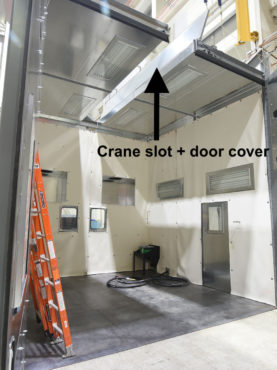
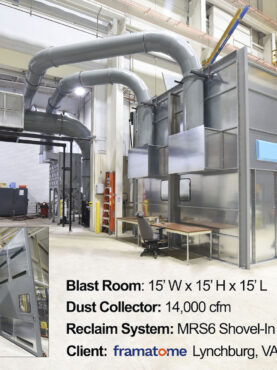
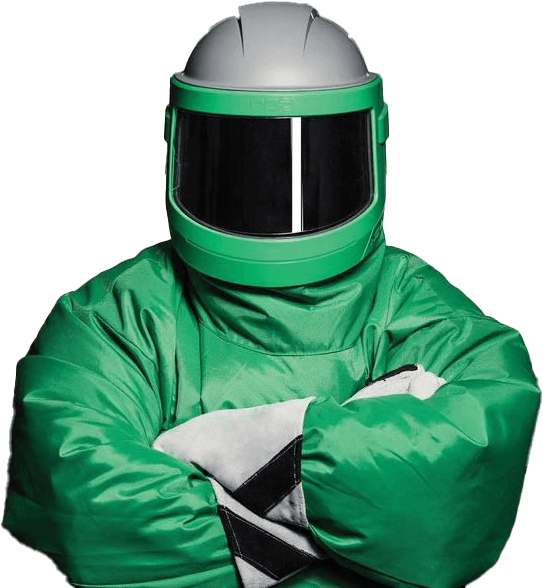
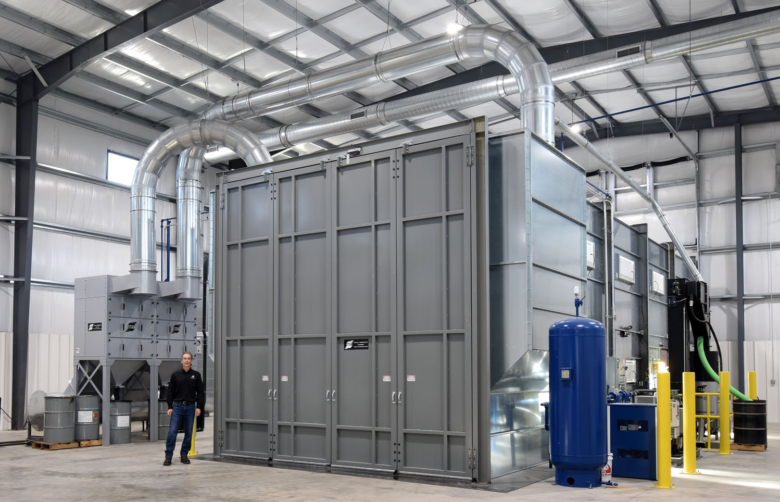
A blast room is a large enclosure designed to remain sealed to prevent the abrasive blast media and dust from escaping. Blast operators, who wear heavy duty blast suits and helmets, work inside the room — blasting the surfaces of objects to meet the specifications needed for the finished product.
Typically, blast rooms contain lights, product entry/exit doors and a personnel door. Although each application may require the use of different pieces of equipment, a blast room contains several key components:
- Blast equipment – An air blasting system commonly consisting of a blast machine (blast pot), which can be filled with various abrasive blasting medias.
- Media reclaim system – A media reclamation/recovery system, used to collect abrasive media so it can be re-used. These can be pneumatic or mechanical (bucket elevator) systems, installed on or in the floor of the blast room.
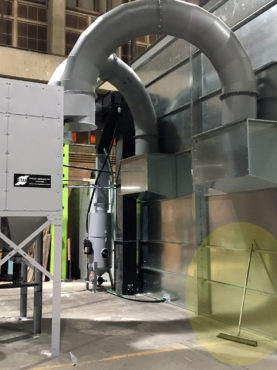
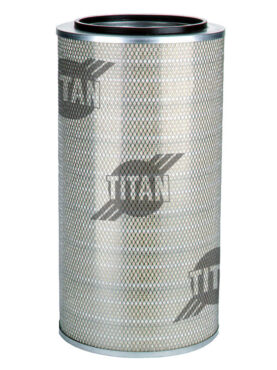
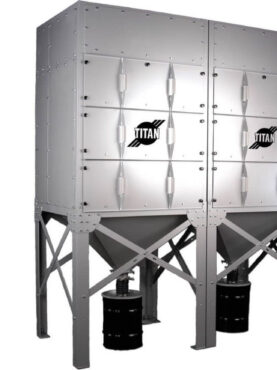
- Dust collector – A dust collection system is the most important component of an abrasive blast room. The dust collector filters the air in the room, allowing maximum visibility and safety for the blast operator, and preventing particulate matter from escaping.
- Control panel – Central to the entire blast room operation, the Control Panel connects to the motor starters, Start/Stop buttons, room lights, system operating lights, etc.
Additional equipment and custom features can be added for convenience and improved usability, such as openings for overhead cranes, rubber lining, 3-axis man lifts, large capacity media storage hoppers, HEPA filters, etc.
To learn more about blast rooms and the various components of each, see our Custom Blast Rooms page.
Q: What are typical or standard blast room sizes?
Titan specializes in custom blast rooms, built to order, based on each customer’s unique requirements. These custom blast rooms come in many sizes, some of which are big enough to accommodate rail cars, commercial and military vehicles, construction equipment, and aircraft.
Titan also offers three, easy-to-install, Pre-Engineered blast room packages:
✔️ 10’ x 10’ x 10’
✔️ 10’ x 10’ x 15’
✔️ 15’ x 10’ x 25’
These high-end systems come complete with a media reclaim system, cartridge dust collector, and blast machine – making them an economical alternative to our Custom Blast Rooms. You can install the system yourself or have Titan do it.
See our Pre-Engineered Blast Rooms for details.
Q: How many man doors are required in a blast room?
It depends on the size of the blast room, the location, and the application. A standard size sandblast room typically has one personnel/man door; larger rooms can have two or more man doors.
In addition, a blast room can have one entry / exit door, or it can have pass-through doors on either end, large enough to accommodate a forklift, vehicle, or very large assembly.
Q: What size dust collector do I need for my blast room?
The typical calculation for dust collector sizing is determined by the following formula:
Width of Room x Height of Room x Cross Sectional Air-Speed (FPM) = C.F.M.
The cross sectional air speed is typically 50 f.p.m. for steel grit abrasive and 60 f.p.m. for non-ferrous mineral abrasives.
If you’re considering a custom Titan blast room, we’ll make this determination for you.
Q. What is a blast cabinet?
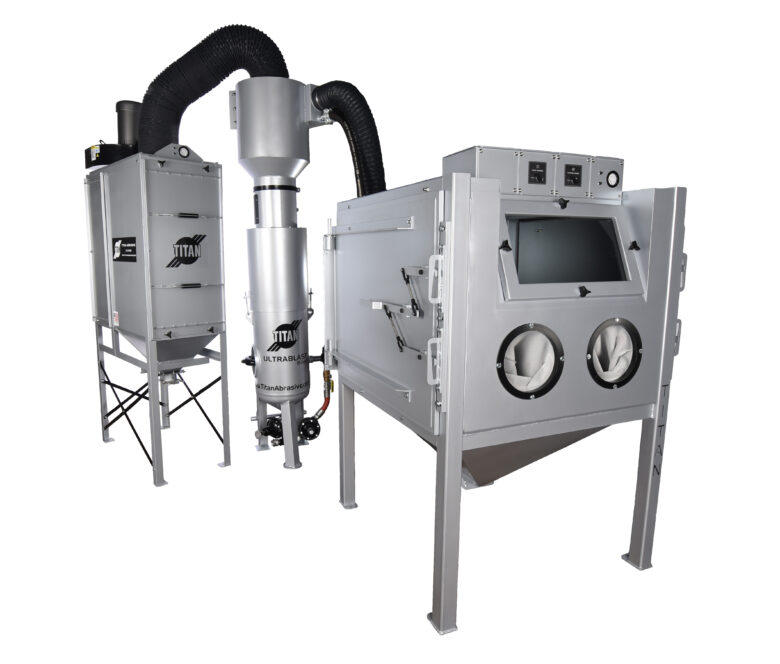
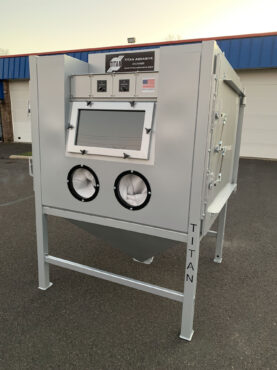
A blast cabinet, like a blast room, is essentially a closed loop system that allows the operator to blast the part and recycle the abrasive. It usually consists of four components: the containment (cabinet), the abrasive blasting system, the abrasive recycling system, and the dust collector.
The operator, however, stands outside the blast cabinet and places his arms in gloves attached to glove holes on the cabinet front. He views the part through a view window, turning the blast on and off using a foot pedal.
Q: Which is better for heavy parts – a blast room or blast cabinet?
Because a blast room is exceedingly heavy, it requires a solid foundation of at least 6″ thick concrete. Consequently, a blast room has a floor capable of supporting the room itself and parts that can weigh as much as 10 tons or more.
Standard blast cabinets can’t hold nearly the same weight. If you’re going to be blasting heavy parts (i.e., over 1,000 lbs), you need to provide structural support to the cabinet.
The weight of your parts may necessitate the addition of a turntable so that the part can be spun around inside the cabinet to ensure all surfaces get blasted. Sometimes, a track extension and work cart are required as well.
Operators can slide the turntable out of the cabinet through the swing doors (or through an optional vertical sliding door), drop the part onto the turntable with a forklift or manually, and slide the part back inside.
See also: Seven Custom Options You Can Add to Your Titan Blast Cabinet
Q: How do I decide between a smaller blast room or blast cabinet?
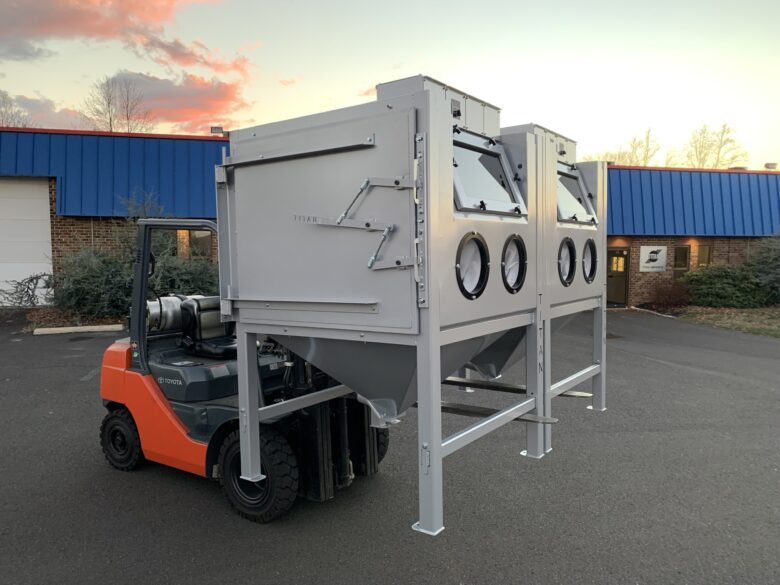
Titan blast cabinets are easy to add to your shop floor and can be moved when necessary using our lifting bars. Blast rooms, on the otherhand, require several days of installation time, and once installed, cannot be (easily) moved.
Whether you need a blast room or a blast cabinet depends on your application – as seen in the following chart:
| Blast Cabinet vs. Blast Room | Titan Blast Cabinet | Titan Blast Room |
|---|---|---|
| Need to blast small parts cost-effectively | ||
| Need to blast large or heavy parts, such as pipe, vehicles, jet engines | ||
| Has to withstand multiple shifts / heavy duty use | ||
| Has to be portable, easy to move, quiet | ||
| We need some customizations | ||
| We want to install it fast so we can start blasting |
Q. We’re thinking of bringing blasting in-house. Do you have advice for us?
Yes, see our write up: The Pros and Cons of Blasting In-House versus Outsourcing. You’ll find answers to most of your high-level questions about what to consider when making this change.
Have additional questions?
Talk to Titan President Brandon Acker for expert advice. Call the Titan office at 215-310-5055 or email sales@titanabrasive.com.

Brandon Acker: President
Brandon purchased Titan Abrasive from his uncle and founder in 2013. Titan has since redesigned its entire product line to solve dozens of industry challenges.
Brandon purchased Titan Abrasive from his uncle and Titan founder, Bruce Maurer, in 2013 after spending five years learning the ins and outs of the business. He and VP of Engineering Brian Fox have completely redesigned the entire product line to solve the dozens of challenges that have plagued the blasting industry for decades.
Brandon is passionate about American manufacturing, the jobs it creates, the quality produced, and the bright future that lies ahead. He’s a frequent guest on manufacturing podcasts where he shares his deep industry expertise. Brandon holds a Bachelor of Science degree from Arizona State University.